Conference on Robot Learning (CoRL) 2026

RoboReel

A benchmark for evaluating robot skill learning by observation — paired real‑world human videos and simulated robot trajectories across ten manipulation tasks.

Weiwei Gu1,* · Anmol Gupta1,* · Anant Sah1,* · Ryan Varghese1 · Lalitha Shreya Vanam1 · Prabhath Adireddi1 · Peter Karkus2 · Nakul Gopalan1

1Arizona State University  ·  2NVIDIA
*Equal contribution

Arizona State University
Paper
Abstract

Why another benchmark?

Learning from Observation (LfO) is a fundamental robotic capability that replicates how humans and animals socially learn from each other. Beyond its biological parallels, this modality offers a practical solution for data scaling in sample‑inefficient, data‑starved domains like robotics. Recent work has demonstrated promising results in learning manipulation skills from human videos, yet progress in this area remains difficult to assess: existing methods vary widely in assumptions, hardware choices, and environment setups, making meaningful comparisons — and identifying real advances — hard to come by.

To address this, we introduce RoboReel: a unified benchmark for evaluating models that learn policies from human videos. RoboReel bundles real‑world human demonstration videos, simulated robot trajectories, and evaluation environments across ten manipulation tasks, with four test suites that probe robustness to visual distractors and the ability to complete long‑horizon tasks. We evaluate learning‑from‑observation models from three different representational categories — over seven state‑of‑the‑art algorithms, including our own VLA‑based variants — and analyze where each family succeeds and fails. Our results show that long‑horizon tasks and tasks with low manipulation tolerances remain challenging for every current method.

10
manipulation tasks, each with a paired sim twin
2,000
real‑world human demo videos
7H+
of calibrated multi‑view data
4
synchronized camera views
4
test suites (ND · WD · ED · PD)
7+
SOTA baselines evaluated

How RoboReel compares

RoboReel is the only benchmark that pairs multi‑view, distractor‑annotated real‑world human video with a matching evaluation environment.

Dataset Real‑world
human vid.
Human demo.
w/ distractions
Multi‑view
demo.
Paired real‑world
human vid. eval env.
Env. w/
distractions
Multi‑view
env.
Articulated
objects
Long
horizon
RoboCerebra
LIBERO
RoboCasa
VLABench
MimicGen
EgoVerse
Human2Robot
RH20T
MimicDroid
RoboReel (Ours)
Benchmark

How RoboReel is built

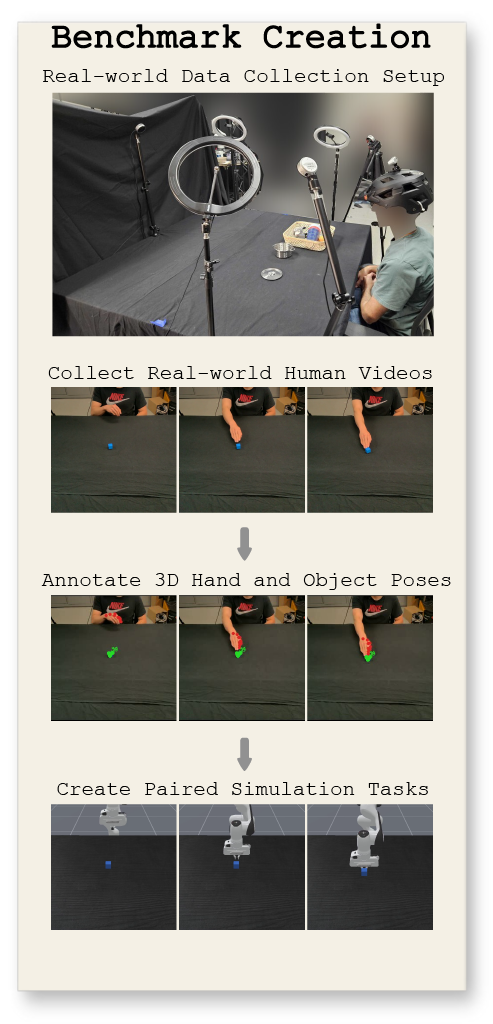
Six participants perform each task at a calibrated tabletop rig. Their videos are annotated with 3D hand and object poses, then mirrored into a digital‑twin simulation with matching objects, textures, and camera poses.

RoboReel data pipeline: real-world capture rig, human video collection, 3D hand/object pose annotation, and paired simulation tasks
  1. Real‑world data collection setup

    A calibrated tabletop rig: three fixed RealSense L515 cameras (front, left, right) plus a helmet‑mounted RealSense D435 for an egocentric view.

  2. Collect real‑world human videos

    Six participants demonstrate each of the ten tasks under both clean and visually distracted conditions — 100 demos per task per condition.

  3. Annotate 3D hand and object poses

    Per‑frame hand and object keypoints are recovered in a shared, calibrated coordinate frame, powering the Pose‑Defined test suite.

  4. Create paired simulation tasks

    A ManiSkill / SAPIEN digital twin reconstructs every object's mesh, texture, and the real camera geometry, so sim and real line up visually and metrically.

Four test suites

One benchmark, four axes of difficulty

Three suites probe robustness to visual distractors under different train/eval regimes; the fourth is a calibrated suite for keypoint‑ and pose‑based methods.

No Distraction (ND)

Train
Human + robot data, no distractors
Eval
Demo environment, no distractors
Tests
Raw LfO capability under clean conditions

With Distraction (WD)

Train
Human + robot data with distractors
Eval
Demo environment with distractors
Tests
In‑distribution robustness to clutter

Evaluation Distraction (ED)

Train
Clean data only
Eval
Distractors added at test time only
Tests
Robustness to an unseen distribution shift

Pose Defined (PD)

Train
3D hand‑pose annotated demos
Eval
Calibrated env., shared action space
Tests
Whether pose annotations beat raw pixels
Tasks

Ten tasks, real and paired‑simulated

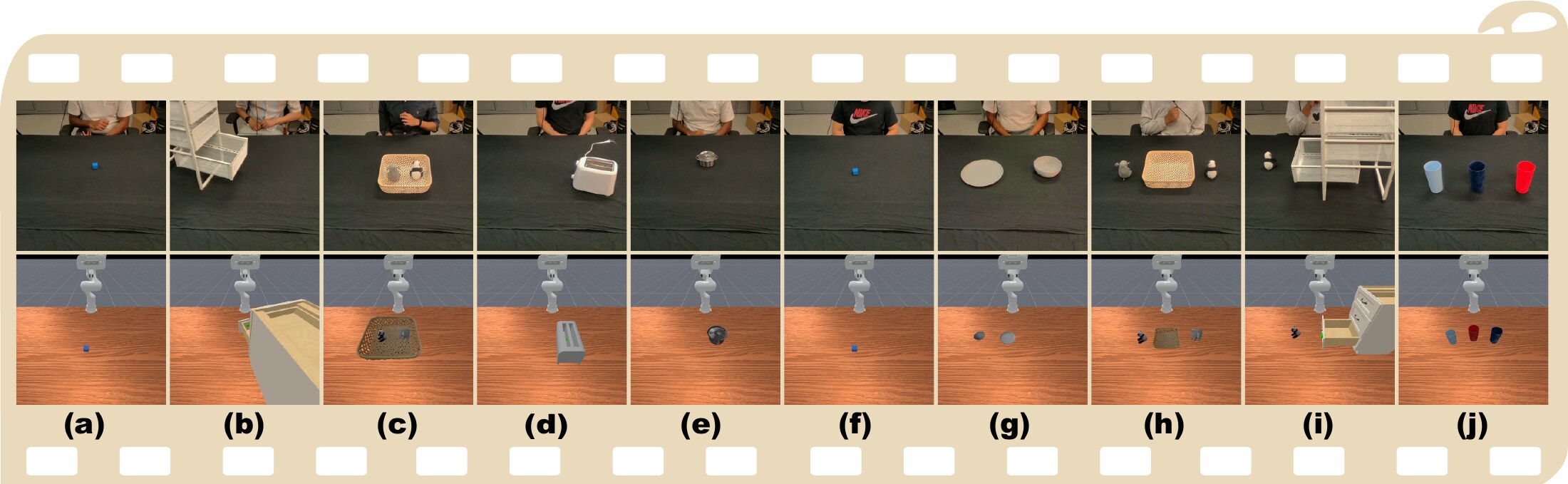
Every task is filmed with a real human demonstrator (top row) and rebuilt as a matching digital twin (bottom row) so any LfO method can be evaluated on identical geometry, texture, and camera pose.

Filmstrip of the ten RoboReel tasks, real human demo above and paired simulation below, for each task

Select a task to watch its human demonstration and paired robot rollout

Pose‑Defined suite

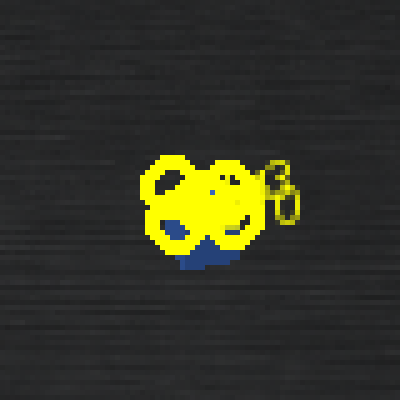
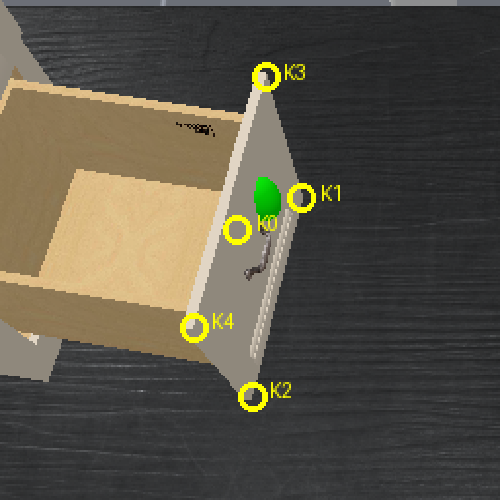
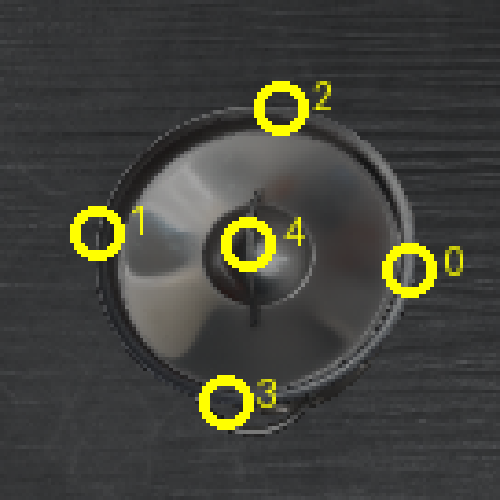
Calibrated 3D keypoint annotations

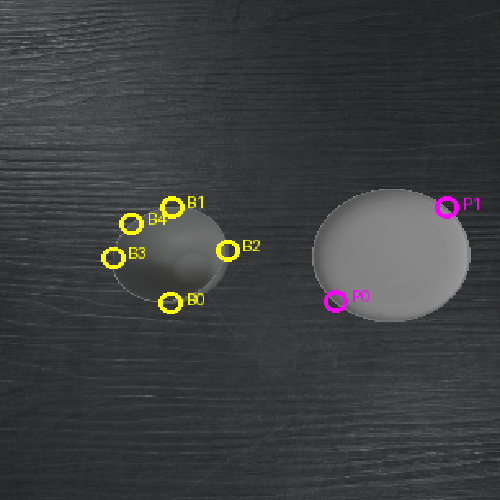
Every human demo also carries per‑frame hand and object keypoints in a shared, calibrated coordinate frame — the input to keypoint‑based LfO methods like PointPolicy.

Keypoint annotation for Pick Cube: gripper keypoint K0 and cube keypoint
Pick Cube — gripper + object keypoints
Keypoint annotation for Close Drawer, overhead camera: K0-K4 on drawer front
Close Drawer — 4 corner keypoints (overhead)
Keypoint annotation for Open Lid
Open Lid — lid + basket keypoints
Keypoint annotation for Bowl on Plate
Bowl in Plate — bowl + plate keypoints
Baselines

Three ways to learn from a human video

Every baseline we evaluate shares one skeleton: watch a human video, build a representation of it, hand that to a policy. What separates the three families is what sits in the middle.

A ♠ ♥ ♣

Explicit representation

Video → language

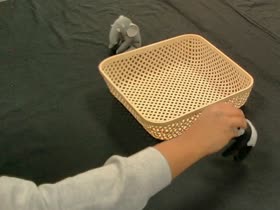
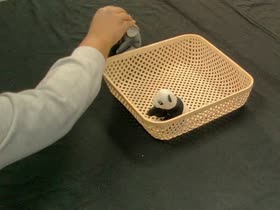
Human demo video
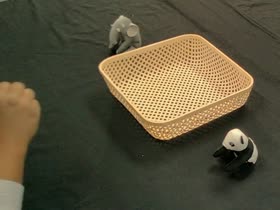
Human reaching for a panda toy beside a basket
Human grasping the panda toy
Panda toy placed inside the basket
Pre‑trained VLM e.g. Qwen3‑VL‑4B
Language instruction

“Put the panda toy in the basket, then put the elephant in the basket.”

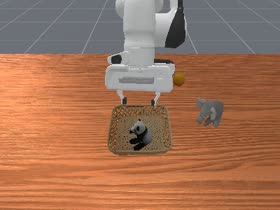
Simulated robot arm above the basket Sim. observation
Down‑stream VLA or planner acts on the sentence alone

A pre‑trained VLM watches the demo and writes down what it saw. Everything downstream sees only that sentence — the video itself is discarded, so any detail the words miss is gone.

Baselines SeeDo VLM + π₀.₅ π₀.₅ (expert language)
B ♠ ♥ ♣

Implicit representation

Video → latent

Human demo video
Pre‑trained visual encoder uniform · keyframe sampling
Latent video encoding

Visual tokens — a skill embedding, never words

Sim. observation
Down‑stream end‑to‑end policy conditioned on the embedding

An encoder compresses the demo into latent skill tokens that condition the policy directly. Nothing has to survive a round trip through language — and this family wins on every suite.

Baselines Vid.‑cond. π₀.₅ (Uniform) Vid.‑cond. π₀.₅ (Keyframes) Vid2Robot UniSkill
C

Keypoint‑based learning

Video → 3D keypoints

Pose‑defined demo
Human demo frame annotated with hand and object keypoints
Keypoint tracking + retargeting DIFT · CoTracker
3D keypoint trajectory

Hand + object keypoints, in the robot’s frame

Calibrated env.
Imitation‑learning policy predicts the next end‑effector keypoints

Hand and object keypoints are tracked through the demo and retargeted into the robot’s end‑effector frame, so human and robot share one action space — but grasp pose is hard to read off points alone.

Baselines PointPolicy

Introduced and trained in this work Language oracle — expert‑written instructions, to upper‑bound the VLM’s output Suits mark the test suites each family is scored on.

Results

Success rate by task and test suite

Mean ± std success rate (%) over 3 seeds. Red bold marks the best result in the column; black bold marks the best result within a model family.

FamilyModelBowl in
Plate
Close
Drawer
Empty
Basket
Open
Lid
Pick
Cube
Press
Toaster
Push
Cube
Stack
Cups
Toys in
Basket
Toy in
Drawer
ExplicitSeeDo71.3±2.2N/A7.8±1.954.1±3.6N/AN/AN/A0.0±0.018.7±1.9N/A
VLM + π₀.₅1.7±1.788.3±3.31.7±1.720.0±2.96.7±1.731.7±3.318.3±1.70.0±0.00.0±0.016.7±4.4
Implicitπ₀.₅ (Uniform)31.7±3.398.3±1.718.3±6.793.3±4.455.0±5.883.3±3.378.3±6.011.7±3.320.0±2.916.7±7.3
π₀.₅ (Keyframes)46.7±6.0100.0±0.020.0±2.973.3±1.723.3±7.388.3±6.7100.0±0.08.3±3.321.7±3.320.0±7.6
Vid2Robot1.7±1.721.7±3.33.3±1.73.3±3.31.7±1.721.7±6.05.0±2.93.3±1.70.0±0.00.0±0.0
UniSkill0.0±0.066.7±8.80.0±0.08.3±1.710.0±2.925.0±10.00.0±0.00.0±0.00.0±0.00.0±0.0
FamilyModelBowl in
Plate
Close
Drawer
Empty
Basket
Open
Lid
Pick
Cube
Press
Toaster
Push
Cube
Stack
Cups
Toys in
Basket
Toy in
Drawer
ExplicitSeeDo66.3±0.4N/A4.9±2.037.8±3.1N/AN/AN/A0.0±0.011.1±2.3N/A
VLM + π₀.₅30.0±7.663.3±4.413.3±1.718.3±4.45.0±5.013.3±1.715.0±5.00.0±0.01.7±1.75.0±2.9
Implicitπ₀.₅ (Uniform)86.7±4.486.7±3.325.0±2.973.3±10.113.3±6.045.0±7.671.7±8.35.0±0.05.0±2.923.3±3.3
π₀.₅ (Keyframes)88.3±7.385.0±5.021.7±7.385.0±2.948.3±6.056.7±6.021.7±6.08.3±4.43.3±1.718.3±1.7
Vid2Robot6.7±4.410.0±5.83.3±3.30.0±0.00.0±0.030.0±5.08.3±3.30.0±0.00.0±0.00.0±0.0
UniSkill0.0±0.056.7±13.610.0±2.921.7±6.71.7±1.721.7±7.38.3±1.70.0±0.00.0±0.00.0±0.0
FamilyModelBowl in
Plate
Close
Drawer
Empty
Basket
Open
Lid
Pick
Cube
Press
Toaster
Push
Cube
Stack
Cups
Toys in
Basket
Toy in
Drawer
ExplicitSeeDo66.3±0.4N/A4.9±2.037.8±3.1N/AN/AN/A0.0±0.011.1±2.3N/A
VLM + π₀.₅6.7±3.361.7±3.35.0±5.06.7±1.711.7±4.415.0±5.06.7±1.70.0±0.00.0±0.00.0±0.0
Implicitπ₀.₅ (Uniform)31.7±4.458.3±8.318.3±4.461.7±4.425.0±5.815.0±5.06.7±4.45.0±2.911.7±4.46.7±1.7
π₀.₅ (Keyframes)25.0±5.070.0±2.921.7±4.463.3±4.430.0±5.026.7±4.431.7±3.311.7±4.418.3±3.36.7±1.7
Vid2Robot0.0±0.023.3±1.75.0±2.90.0±0.00.0±0.023.3±9.36.7±3.30.0±0.00.0±0.00.0±0.0
UniSkill0.0±0.063.3±14.80.0±0.018.3±1.71.7±1.728.3±8.80.0±0.00.0±0.00.0±0.00.0±0.0

N/A — SeeDo's action vocabulary is restricted to pick‑and‑place tasks.

PointPolicy success rate — Pose‑Defined suite (♦)
0 25 50 75 100 95 95 Push Cube 48 50 Close Drawer 10 5 Open Lid 8 8 Pick Cube 2 0 Bowl in Plate
No distraction With distraction

Keypoints capture motion, not grasps

PointPolicy tracks the demonstrator's trajectory well on tasks that tolerate a few centimeters of error — Push Cube and Close Drawer stay strong even under distraction. But success collapses on anything that needs a precise grasp (Open Lid, Pick Cube, Bowl in Plate): a ~2–3 cm precision floor in the rigid‑transform action recovery means the policy can navigate to the right sub‑region of the workspace but can't reliably close the last few centimeters onto a graspable surface.

Analysis

Six questions about current LfO methods

Q1. Which model family performs best?
Video‑conditioned π₀.₅ variants win across every test suite, which we attribute to large‑scale VLA pretraining giving better correspondence between human‑video features and robot actions. Uniform and keyframe sampling are close in ND/WD, where train and eval share the same distraction condition — but the gap widens sharply in ED, where keyframe sampling wins on 7 of 10 tasks. Keyframes capture task‑relevant moments in the demonstration, making the policy more robust to the visual domain shift introduced at evaluation time.
Q2. Does task length affect performance?
Yes — task horizon has a clear negative effect on success rate across every suite and family. Long‑horizon tasks (Empty Basket, Stack Cups, Toys in Basket, Toy in Drawer) require several sequential sub‑goals, and failure at any one fails the whole task. Short‑horizon tasks like Push Cube, Pick Cube, and Close Drawer see substantially higher success. Even the strongest baseline stays below 25% on long‑horizon tasks.
Q3. Do VLAs benefit more from explicit language guidance?
We expected internet‑scale pretraining to let VLMs summarize demonstrations into useful instructions better than implicit encoders. The opposite holds: implicit representation consistently outperforms explicit representation across all three suites. We hypothesize that implicit methods' additional exposure to robot‑trajectory data during pretraining helps them overcome VLMs' known weakness in visual‑temporal reasoning.
Q4. Can models learn tasks with low manipulation tolerances?
Press Toaster and Stack Cups have the least tolerance for error. π₀.₅ tops 88% success on Press Toaster in the ND suite, but performance degrades steadily from ND → WD → ED as distractor clutter confuses localization of the small target button. Stack Cups stays low across every suite and model — it combines a long horizon with precise placement, compounding the difficulty.
Q5. Do calibrated keypoints help learning from observation?
Partially. Keypoint annotations help PointPolicy learn overall trajectory behavior — strong, distraction‑robust performance on Push Cube and Close Drawer — but this doesn't translate into consistent gains. Performance drops sharply on tasks that require precise grasping (Pick Cube, Open Lid, Bowl in Plate): keypoints alone can't fully specify a good grasp configuration on objects like bowls and handles.
Q6. What are the fundamental limitations of current LfO methods?
Three gaps recur across every family: compounding errors make long‑horizon tasks unreliable; precise manipulation in cluttered scenes is hard for every method; and while large‑scale VLA pretraining gives a strong foundation, it hasn't yet closed the gap to the fine‑grained precision these tasks demand.
Limitations

What RoboReel doesn't cover — yet

Goal‑based tasks only

Success is checked at a terminal state, so non‑Markovian or open‑ended skills that never resolve to a single goal condition fall outside the benchmark's scope.

No soft‑body objects

Deformable‑object physics remain too unreliable to simulate accurately, so every task uses rigid bodies with articulated‑object support for drawers and lids.

Single‑arm only

Every task uses one Franka Panda arm. Bimanual coordination is out of scope, and would meaningfully complicate action generation for every model evaluated here.
Cite this work

BibTeX

@misc{gu2026monkeyseemonkeydo,
  title         = {Monkey See, Can Monkey Do? A Benchmark for Evaluating Robot Skill Learning by Observation},
  author        = {Weiwei Gu and Anmol Gupta and Anant Sah and Ryan Varghese and Lalitha Shreya Vanam and Prabhath Adireddi and Peter Karkus and Nakul Gopalan},
  year          = {2026},
  eprint        = {2609.08209},
}